Chrome Versus Nickel Plating: Which Finish is Right for You?
August 03, 2026
August 03, 2026
Two of the most widely specified electroplated finishes in the metal finishing industry are chrome and nickel. Both deliver striking visual results. Both offer meaningful corrosion and wear protection. But they are not interchangeable, and selecting the wrong one for a given application creates problems that range from premature failure to customer complaints to regulatory exposure.
This article examines the technical differences between chrome and nickel plating across five critical dimensions: aesthetics, corrosion resistance, hardness and wear, maintenance requirements, and cost. With those differences clearly established, the decision framework becomes straightforward.
Understanding What "Chrome" and "Nickel" Actually Mean
Before comparing the two finishes, a critical clarification: "chrome" and "nickel" each describe families of electroplating processes, not single monolithic options.
Chrome plating refers to:
Decorative chrome: a thin chromium deposit (typically 0.25–0.5 µm) applied over a nickel underplate. The chrome layer provides the mirror-bright appearance and scratch resistance; the nickel layer carries the structural corrosion protection.
Hard chrome (industrial chrome): a thick chromium deposit (25–500+ µm) applied for dimensional restoration, wear resistance, and low friction on industrial components such as hydraulic rods, dies, and machine tools.
Nickel plating refers to:
Electrolytic nickel: deposited using direct current in a nickel sulfamate or nickel sulfate/chloride bath; produces deposits with controlled hardness, luster, and stress characteristics.
Electroless nickel (ENP): deposited autocatalytically without electric current, using a chemical reduction reaction; produces highly uniform deposits across complex geometries including blind holes and recesses.
These distinctions matter enormously for application selection, and collapsing them into a single "chrome vs. nickel" comparison misses the engineering nuance that high-performance surface finishing demands.
1. Aesthetics: Mirror Shine vs. Warm Elegance
The visual signature of chrome is unmistakable: a cool-toned, mirror-bright reflectance that has defined automotive trim, bathroom fixtures, and industrial components for nearly a century. Decorative chrome achieves this effect through the thin chromium topcoat, which produces an exceptionally smooth, specular surface. The result reads as modern, precise, and aggressive, which is why it remains the default choice for high-visibility automotive applications such as rims, bumpers, grilles, and trim.
Nickel, by contrast, offers a warmer aesthetic palette. Depending on bath chemistry and brightener selection, nickel deposits can range from a semi-bright warm silver to a richly lustrous gold-toned satin. Electroless nickel in particular produces a uniform, low-reflectance finish that reads as understated and refined — well-suited for interior architectural hardware, cabinet fixtures, and lighting components where the goal is complement rather than contrast.
The practical implication: if the specification requires a cold-toned mirror finish, chrome wins on aesthetics. If the requirement is a warm, versatile finish with uniform coverage across a complex part, nickel is the engineered choice.
2. Corrosion Resistance: Where Nickel Has the Structural Advantage
When corrosion resistance is the primary performance requirement, electroless nickel consistently outperforms hard chrome when used as a standalone deposit.
The data is clear: electroless nickel forms a dense, non-porous barrier over the substrate, capable of exceeding 1,000 hours in ASTM B117 salt spray testing without base metal corrosion. This performance stems from the autocatalytic deposition mechanism, which produces a finely crystalline structure with minimal through-porosity.
Hard chrome, used alone, is significantly more porous at practical deposit thicknesses — and its corrosion resistance reflects that fact. Hard chrome deposits often fail salt spray testing in as little as 24 hours when applied directly to steel without a nickel underplate.
This is why decorative chrome systems are engineered as a stack: nickel provides the corrosion barrier, chrome provides the appearance and surface hardness.
For applications demanding superior corrosion, electroless nickel is the technically preferred choice. Its dense deposit structure and uniform coverage make it the metal finishing solution for environments where substrate integrity cannot be compromised.
PAVCO®'s post-plate solutions, including trivalent passivates and topcoats, can be applied over nickel deposits to further enhance corrosion resistance for the most demanding service conditions.
3. Hardness and Wear Resistance: Chrome's Industrial Strength
For applications where surface hardness and wear resistance are the governing requirements, hard chrome holds a commanding advantage over standard electrolytic nickel.
Industry-verified data places hard chrome at 68–72 HRC, among the highest surface hardness values achievable through any electroplating process. This performance makes hard chrome the finish of choice for hydraulic cylinder rods, piston rings, industrial dies, measuring tools, and any component subject to repetitive sliding contact or abrasive wear.
Electroless nickel, as-plated, typically delivers 45–57 HRC. However, a critical advantage of electroless nickel is its response to heat treatment: when baked at elevated temperatures post-plating, electroless nickel can achieve hardness values approaching 70 HRC (1,000 HV), making it a competitive alternative to hard chrome in applications that can tolerate a post-plate bake cycle.
For finishers evaluating abrasion-resistant coating options, the choice is not always binary. Heat-treated electroless nickel offers a compelling combination of corrosion resistance, uniformity, and hardness that hard chrome cannot match in geometrically complex parts.
4. Geometry and Coverage Uniformity
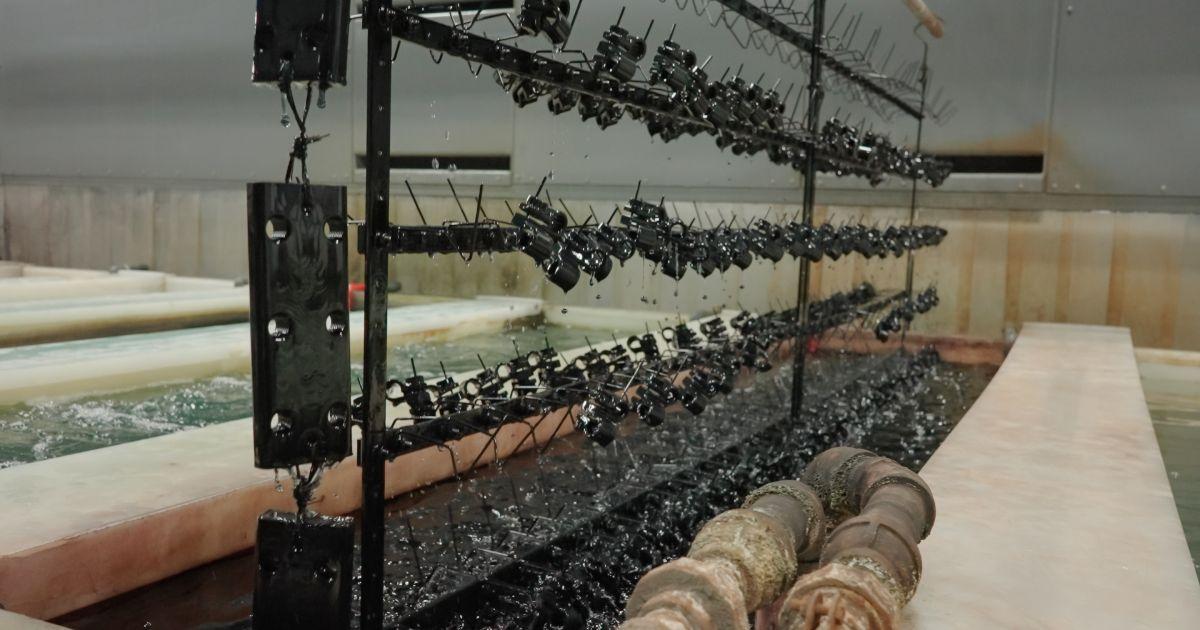
One of the most operationally significant differences between chrome and nickel plating is their behavior on complex part geometries.
Electroless nickel deposits uniformly across the entire exposed surface. Every surface that contacts the bath solution receives the same deposit thickness. This makes electroless nickel the preferred process for:
Precision components where dimensional tolerance control is critical
Parts with complex internal geometries that cannot be adequately reached with electrolytic current
Applications requiring uniform corrosion protection on all surfaces, not just line-of-sight areas
Chrome plating, whether decorative or hard, relies on electrolytic current, and current distributes unevenly across complex geometries. Edges and high-points receive more deposit than recesses and low-current-density areas. Specialized anodes, conforming fixtures, and process adjustments can improve distribution, but they add cost and process complexity. For parts with deep recesses, blind holes, or tight internal radii, chrome can be genuinely difficult to apply at specification thickness.
5. Maintenance Considerations
In service, hard chrome surfaces are extremely durable but show contamination readily. The mirror-bright surface reflects fingerprints, water spots, and airborne deposits conspicuously, requiring regular cleaning to maintain appearance in decorative applications.
Nickel finishes, particularly satin or semi-bright nickel, are far more forgiving. The reduced specularity of a satin nickel finish diffuses reflections rather than concentrating them, making fingerprints and water stains significantly less visible. For architectural hardware, interior fixtures, and any surface subject to frequent human contact, nickel's lower maintenance requirement is a practical advantage.
From a corrosion maintenance standpoint, electroless nickel deposits are self-sealing and do not require supplementary passivation in most applications. Chrome deposits, particularly decorative chrome, are porous at the chromium layer and rely on the nickel underplate for corrosion protection, meaning any breach of the chrome surface (scratch, chip) immediately exposes the nickel layer and, ultimately, the base metal to environmental attack.
For applications requiring a satin finish on metals, electroless nickel is frequently the process that delivers the aesthetic and durability combination that customers expect.
6. Environmental and Regulatory Factors
The regulatory landscape around hexavalent chromium has become progressively more demanding. OSHA 29 CFR 1910.1026 requires stringent exposure controls for any operation generating Cr VI. NESHAP regulations limit Cr VI stack emissions from electroplating facilities. International restrictions are further narrowing the applications where hexavalent chrome is permissible.
Trivalent chromium (Cr III) plating processes have emerged as the technically and environmentally responsible path forward for decorative and some functional chrome applications. Trivalent processes produce chrome-like deposits without the Cr VI regulatory burden, using PAVCO®'s plating technologies that are designed to deliver the aesthetic performance that decorative applications require.
Electroless nickel carries no hexavalent chromium exposure risks, requires no NESHAP reporting, and generates waste streams that are significantly easier to treat than Cr VI operations. For finishers seeking to reduce environmental liability while maintaining or improving finish performance, electroless nickel is a compelling strategic choice.
Partnering With PAVCO® for Your Chrome and Nickel Applications
Whether your line runs decorative chrome over nickel, hard chrome for industrial wear applications, electrolytic nickel, or electroless nickel, PAVCO® has the chemistry and the technical expertise to help you optimize every aspect of your process.
Our complete portfolio of plating technologies spans zinc, nickel, trivalent chromium, copper, tin, and alloy systems, all backed by the rigorous quality management that ISO 9001:2015 certification and NASF Executive Partner status represent.
For finishers exploring the transition from hexavalent chrome to trivalent or nickel alternatives, PAVCO®'s technical service team provides the application-specific guidance needed to make that transition confidently, without compromising the performance your customers expect.
Contact a PAVCO® Technical Service Representative to discuss which finishing technology is right for your next application.
- Share:
-
![Facebook]()
-
![Twitter]()
-
![Mail]()


Related Articles


IT’S HOW YOU FINISH
We’re a developer and supplier of chemistries for the metal finishing industry since 1948.
In PAVCO, we develop products and deliver services of the highest quality at a reasonable cost.