Cross Hatch Test: Troubleshooting Poor Plating Adhesion
August 03, 2026
August 03, 2026
A visually-perfect plated component can fail the cross hatch test, where the coating peels away. For metal finishing professionals, this adhesion failure is frustrating and costly. The cross hatch test assesses the bond strength of an electroplating deposit to the substrate below. When failures occur, the focus must be on finding the process root cause which is often not the plating itself. When included as part of a robust quality management system, the cross hatch test can be a quick and consistent way to measure and maintain coating quality.
How the Cross Hatch Test Works
The cross hatch adhesion test (ASTM D3359, Method B) evaluates coating adhesion through a straightforward procedure:
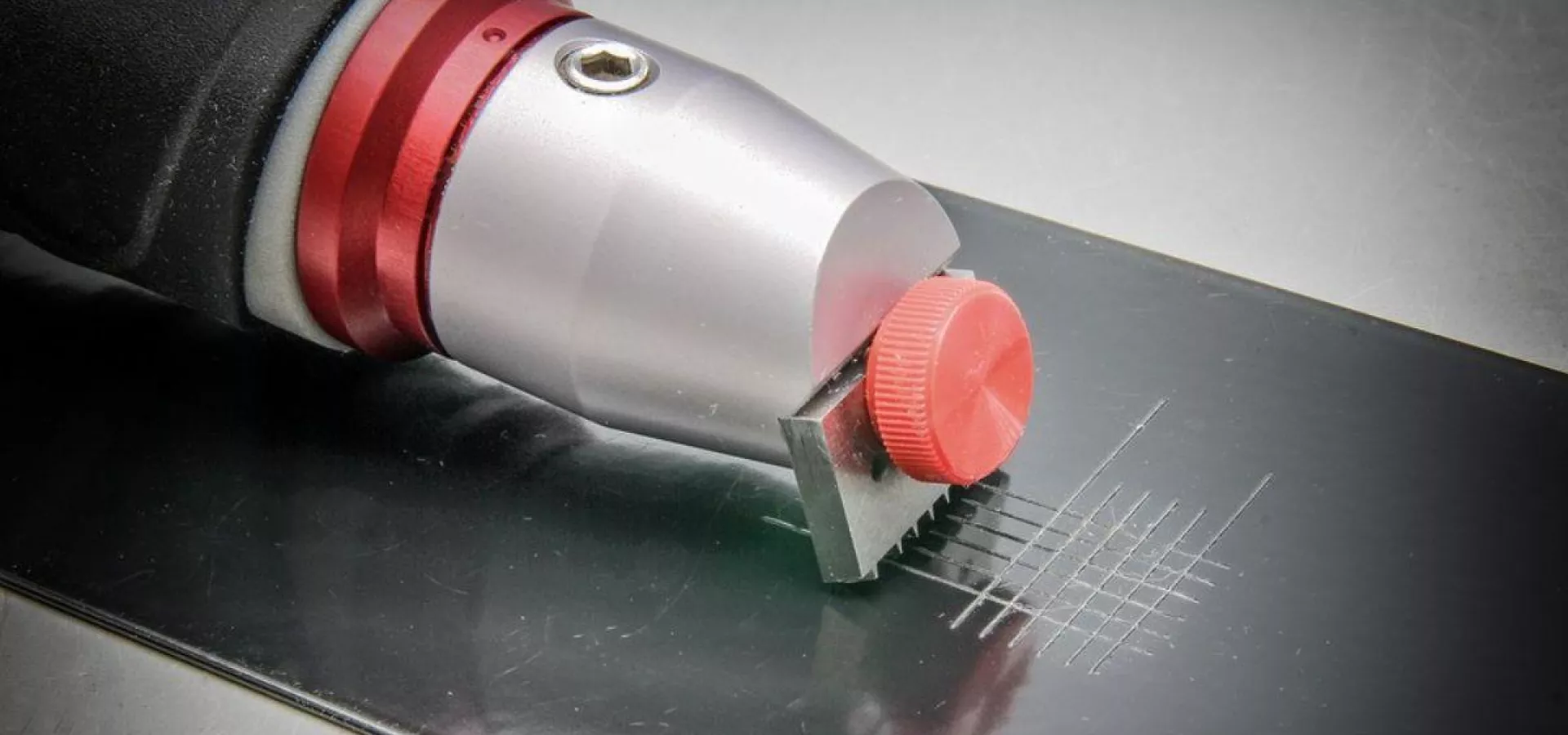
Cut a lattice pattern into the coating surface down to the substrate using a multi-blade cutting tool, creating a grid of small squares
Apply pressure-sensitive adhesive tape firmly over the cross-cut area, usually with a standardized rolling tool
Remove the tape at a 180° angle with a rapid, smooth pull
Evaluate the result by comparing the coating removal pattern against a standardized classification scale
ASTM D3359 Classification Scale
Rating 5B: Clean cut, no peeling. Coating Removal - 0% — edges perfectly smooth.
Rating 4B: Minor flaking at intersections. Coating Removal - Less than 5%.
Rating 3B: laking along edges and intersections. Coating Removal - 5–15%.
Rating 2B: Coating peeled along edges in large ribbons. Coating Removal - 15–35%.
Rating 1B: Coating peeled in large strips. Coating Removal - 35–65%.
Rating 0B: Severe failure. Coating Removal - Greater than 65% of lattice area removed.
For most electroplating specifications, a rating of 4B or 5B is required to pass. Anything below indicates an adhesion deficiency that must be investigated and resolved before production continues.
Critical Test Execution Practices
The cross-hatch test's reliability hinges on consistent execution. To get accurate, reproducible results:
Follow the correct specification (e.g., ASTM D3359 Method A/B, ISO 2409) for blade spacing, tape, and evaluation.
Cut completely through the coating to the substrate to expose interface adhesion issues.
Use the correct method (e.g., X-cut for thicker coatings, lattice cut for thinner coatings) as required by the specification.
Standardize the procedure with SOPs covering blade pressure, speed, tape application/removal, and lighting to minimize operator variability.
Test multiple samples from various positions (high/low current density) in the load to confirm overall process reproducibility and capability.
Root Causes of Poor Plating Adhesion
When the cross hatch test reveals adhesion failure, the source of the problem almost always lies upstream in the process. Industry data consistently identifies inadequate surface preparation as the dominant cause of plating adhesion defects, with optimized cleaning protocols capable of reducing adhesion-related rejects by 25% or more (electroplatingmachines.com, allpcb.com).
The following root causes account for the vast majority of adhesion failures in production environments.
1. Contaminated Substrate Surface
The most common cause of adhesion failure is residual contamination on the substrate at the time of plating. Oils, greases, polishing compounds, shop dust, and fingerprints create invisible barriers that prevent metallurgical bonding between the deposit and the base metal.
Even trace amounts of organic contamination can compromise adhesion. A surface that appears visually clean may still carry contamination measurable only through water-break testing or other analytical methods.
Solution: Implement a verified cleaning sequence that includes alkaline soak cleaning, electrolytic cleaning, and thorough rinsing. For substrates with stubborn contamination, PAVCO®'s complete line of pre-plate solutions provides metal cleaning formulations designed for complex cleaning requirements prior to plating.
2. Failed or Inadequate Activation
After cleaning, the substrate surface must be chemically "activated" — typically through acid pickling or a specialized strike — to remove passive oxide layers and create a surface that is receptive to electrodeposition. If activation is incomplete, too weak, or the part experiences excessive delays between activation and plating, the surface can re-passivate.
Solution:
Verify acid concentration, temperature, and immersion time in the activation step
Minimize dwell time between activation and plating entry
Monitor rinse water quality to prevent drag-in contamination
3. Bath Contamination
Metallic contaminants (iron, copper, lead) and organic contaminants in the plating bath can compromise deposit quality and adhesion. Contamination often manifests as dull deposits, staining, pitting, or delamination, all of which will cause cross hatch test failure.
Solution:
Implement regular Hull cell testing to monitor bath health
Perform carbon treatment on a scheduled basis to remove organic contamination
Use purification procedures recommended by your chemistry supplier
Monitor drag-in from upstream tanks through disciplined rinsing
4. Internal Stress in the Deposit
High internal stress within the plated layer can cause spontaneous delamination, blistering, or cracking — even when the substrate was properly prepared. Internal stress is influenced by:
Current density: Operating above the optimal range increases stress
Additive imbalance: Excessive brightener concentrations are a frequent culprit
Temperature: Bath temperature outside the specified range affects crystal structure
Plating rate: Excessively fast deposition can produce stressed, brittle deposits
Parts with high internal stress may pass the cross hatch test immediately after plating but fail after thermal cycling or aging, making this a particularly insidious failure mode.
Learn how selecting the right finish affects long-term coating integrity when evaluating deposit stress across different plating systems.
5. Hydrogen Embrittlement
For high-strength steel substrates, hydrogen absorbed during pre-plate processing or plating can cause delayed adhesion failure. The mechanism is distinct from surface contamination.
Solution: Apply post-plate baking per ASTM B850 specifications. For comprehensive guidance, review PAVCO®'s post-plate solutions that include passivates, sealers, and topcoats designed to protect the finished deposit.
Partner with the Experts in Surface Finishing
Plating adhesion is a system-level property, it depends on the integrated performance of cleaning, activation, plating, and post-plate steps working together. PAVCO®, with over 75 years of experience in developing finishing technologies and the world's most comprehensive zinc finishing portfolio, provides the chemistry, the technical expertise, and the training resources to help your operation achieve and maintain the adhesion quality your customers demand.
Contact a PAVCO® Representative today to discuss your adhesion challenges and discover solutions tailored to your operation.
- Share:
-
![Facebook]()
-
![Twitter]()
-
![Mail]()


Related Articles

IT’S HOW YOU FINISH
We’re a developer and supplier of chemistries for the metal finishing industry since 1948.
In PAVCO, we develop products and deliver services of the highest quality at a reasonable cost.